
The Job Nobody Trained You For
"I was great at my job, then they made me a manager."
This was an actual comment made during a training this week. If you have ever thought this, you are not alone. It's one of the most common conversations we have in coaching. Someone was the best case manager, the best program officer, the best development associate on the team — so the organization did what organizations do. They promoted them. Nobody handed them a manual. Nobody asked if they wanted to manage people in the first place. They just showed up on Monday with a new title and a team looking to them for answers.
An Old Problem With a New Name
There's actually a name for this: the "accidental manager." Research from the Chartered Management Institute found that 82 percent of people entering management positions have not had any proper training. Nearly half of managers surveyed said colleagues won promotions based on relationships and visibility rather than ability. The cost isn't abstract. That same research linked accidental management to nearly one in three workers walking out the door.
Nonprofits and small businesses aren't immune to this. If anything, we may be more prone to it. Our sector runs lean, so the person who's best at the work is often the only logical choice to lead the people doing the work regardless if leading people is a skill they've had the chance to build. It's not your fault that you were never trained, but it is your role to lead through it. The good news is that leadership is a skill, not a personality trait. It can be learned, practiced, and you can improve.
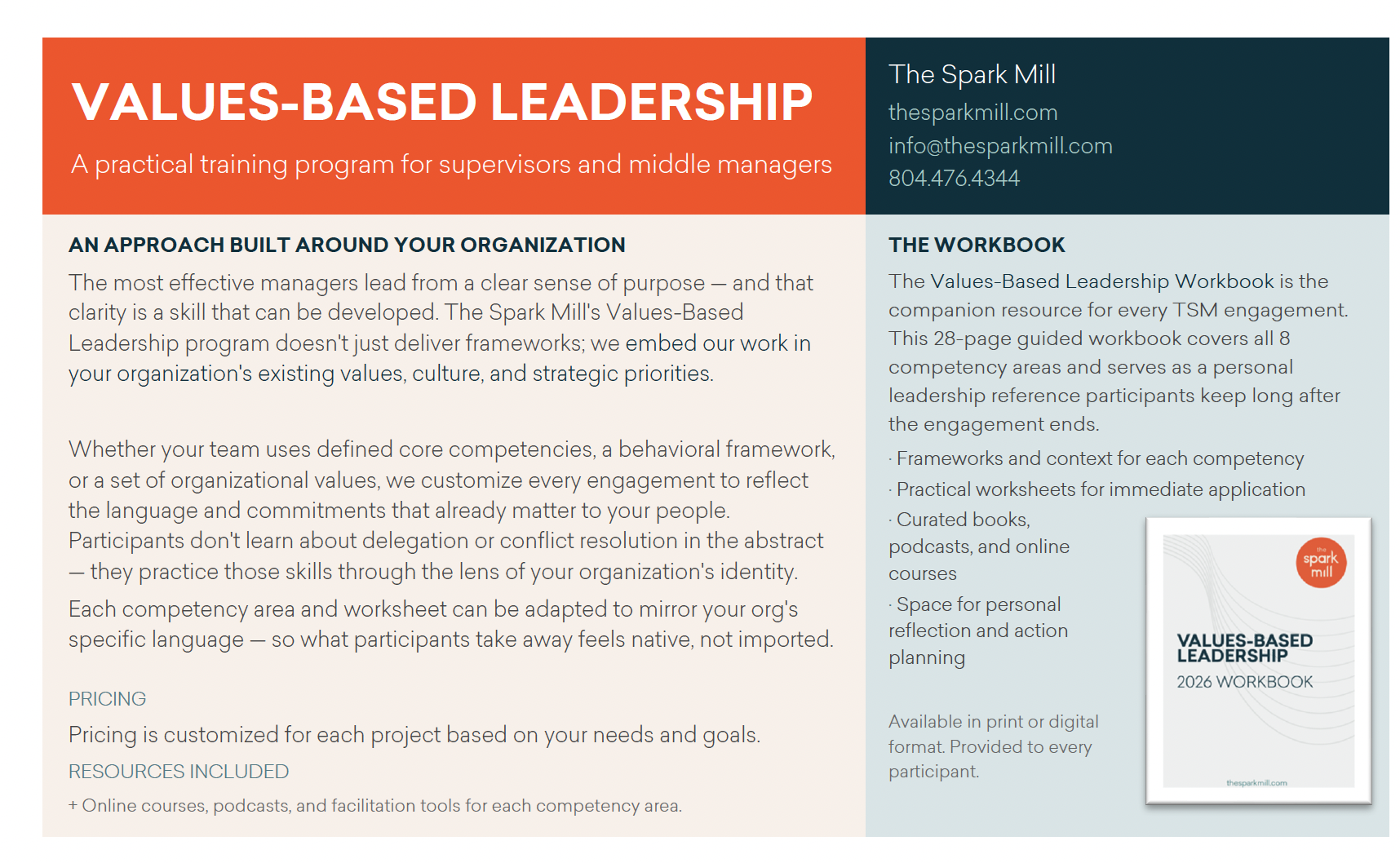
This is why we built our Values-Based Leadership Workbook and Trainings. It's the resource we hand every leader in our training and coaching engagements — a practical, 28-page guide covering eight core competencies, from communication to conflict resolution. We want to give you a peek at three of the tools inside, because they're the ones we find ourselves returning to most often with reluctant, first-time, and quietly-overwhelmed managers alike.
Three Tools for Leading With People, Not Just Over Them
The Communication Compass. Most new managers assume everyone wants to be communicated with the way they do. This tool breaks communicators into four styles — Direct, Supportive, Collaborative, and Analytical — and asks you to name your primary style, your backup style, and the style you personally find hardest to work with. It's a small shift with a big payoff: instead of getting frustrated that a team member wants more detail before deciding, you start to see it as a style difference to manage around, not a character flaw to tolerate.
The Delegation Planning Worksheet. New managers tend to delegate one of two ways: they hold on to everything because "it's faster if I just do it," or they hand off a task with so little context it comes back wrong and confirms their fear that they should've just done it themselves. Our worksheet walks through the questions that actually make delegation work — what's critical about this task, what training the person will need, what the end result should look like, whether you've built in a midpoint check-in. Delegating well isn't about letting go of control. It's about being specific enough, up front, that letting go is safe.
The Managing Up 5 W's. Nobody teaches new managers that managing up is part of the job, but if you supervise people, you're also translating between your team and whoever you report to, and that relationship shapes what your team can actually get done. Before you make an ask of your own supervisor or board, our workbook walks through five questions: What outcome are you asking for? Why does it matter now? When does it need to happen? Where can you point to resources that make the ask easier? Who else needs to be looped in? Getting aligned up front saves the miscommunication and rework that eats up everyone's time later.
Next Steps
If any of this sounds like your team or like you, a few years ago, you're not alone, and you don't have to figure it out solo. Give us a call for a chat. Maybe you find a home in our classes, engagements, and multi-month programs, which cover all eight competencies. Whether you want a team session or a keynote, or individual coaching, we would love to help.